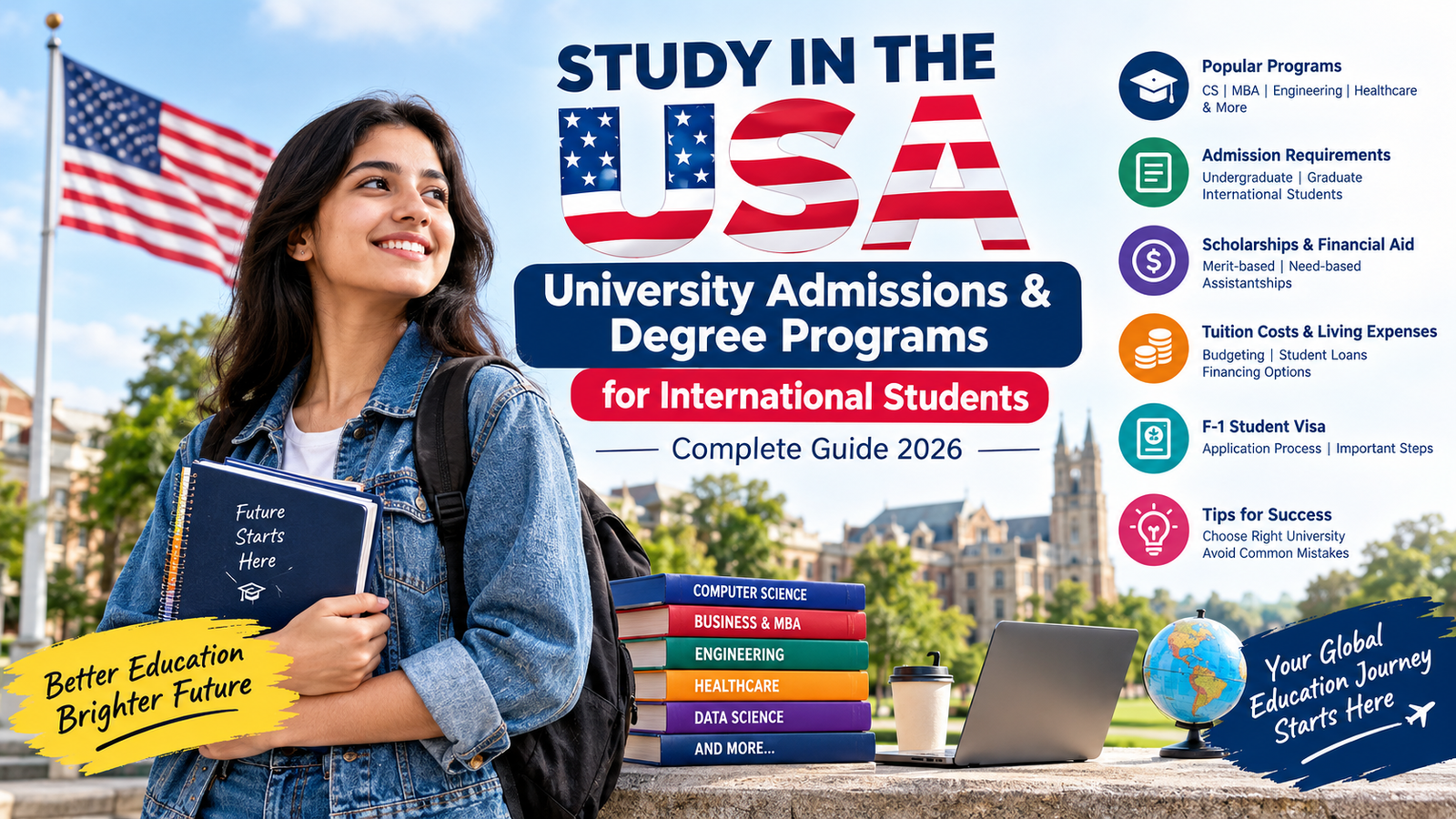
The United States remains one of the world’s most popular destinations for higher education. International students can choose from a wide variety of universities, colleges, community colleges, research institutions, and specialized schools offering programs in business, technology, healthcare, engineering, science, arts, and many other fields.
For students planning to study in the United States in 2026, understanding the university admission process is an important first step. The process can appear complicated because every institution has its own requirements, deadlines, tuition structure, scholarship opportunities, and program options.
A successful application requires more than simply filling out an online form. Students need to research universities, compare degree programs, prepare academic documents, meet English language requirements where applicable, understand the cost of education, and plan for the student visa process.
This guide explains the major parts of USA university admissions and helps international students understand how to choose a university and prepare a strong application.
Why Study at a University in the USA?
The American higher education system offers a large variety of academic and professional opportunities. Students can select from thousands of programs at institutions with different sizes, locations, teaching styles, and areas of specialization.
One of the major advantages of studying in the United States is academic flexibility. Depending on the university and degree program, students may have opportunities to explore different subjects, select elective courses, pursue minors, or specialize in particular areas.
The United States also offers programs at multiple educational levels, including:
- Associate degrees
- Bachelor’s degrees
- Master’s degrees
- Doctoral degrees
- Professional degrees
- Graduate certificates
- Undergraduate certificates
- Continuing education programs
- Selected online degree programs
Students can find programs in traditional academic subjects as well as emerging fields such as artificial intelligence, data science, cybersecurity, digital marketing, business analytics, health informatics, and renewable energy.
EducationUSA, the U.S. Department of State’s international student advising network, highlights the broad range of academic programs and institutional options available to international students.
Types of Higher Education Institutions in the United States
Before applying, international students should understand the differences between the major types of American educational institutions.
Public Universities
Public universities are generally supported in part by state governments. Many have large campuses and extensive academic departments.
They may offer programs in areas such as:
- Computer Science
- Engineering
- Business Administration
- Finance
- Nursing
- Public Health
- Artificial Intelligence
- Data Science
- Education
- Economics
- Environmental Science
International students should remember that tuition for non-resident and international students may differ from tuition charged to eligible in-state students.
The total cost of attendance should also be considered, including housing, food, insurance, transportation, books, and personal expenses.
Private Universities
Private universities receive funding primarily from private sources rather than state governments.
Some private universities are relatively small, while others have large research operations and international student populations.
Tuition at private institutions can be high, but students should not automatically assume that a private university is financially impossible. Some institutions offer merit scholarships, need-based assistance where eligible, or other funding opportunities.
Financial aid policies vary significantly, especially for international students.
For this reason, applicants should carefully review each university’s official financial aid and scholarship information.
Community Colleges
Community colleges often provide two-year academic programs that can lead to an associate degree.
For some students, community college can provide an alternative pathway toward a bachelor’s degree.
A common pathway involves:
- Beginning at a community college.
- Completing eligible academic credits.
- Meeting transfer requirements.
- Applying to a four-year university.
- Completing the remaining requirements for a bachelor’s degree.
However, transfer policies are not identical at every institution.
Students should investigate credit-transfer agreements before beginning a program.
Specialized and Professional Schools
Some institutions focus on particular academic or professional areas.
Examples may include schools specializing in:
- Business
- Technology
- Art and Design
- Music
- Healthcare
- Law
- Aviation
- Hospitality
Students should carefully research institutional accreditation and program-specific requirements before applying.
USA University Admission Intakes in 2026
American universities may offer more than one admission period during the year.
The availability of programs varies by institution.
Fall Intake
Fall is often the largest admission period at many American universities.
A large number of undergraduate and graduate programs begin during this period.
Students who want to begin during the Fall semester should generally start researching universities well in advance.
Application deadlines can vary substantially.
Highly selective programs, scholarship applications, and graduate departments may have earlier deadlines.
Spring Intake
Spring admission can provide an alternative starting point.
However, not every university or degree program accepts new students during the Spring semester.
Students should check whether:
- Their chosen degree is available.
- International applications are accepted.
- Scholarships are available.
- Required courses can begin during the Spring term.
Summer and Other Terms
Some institutions offer Summer terms or additional academic sessions.
Program availability may be limited.
Students should always check the specific university and department rather than assuming that every program has multiple entry dates.
Most Popular Degree Programs in USA Universities
The United States offers academic programs across almost every major field of study.
The right program depends on a student’s interests, academic background, career goals, and financial situation.
Below are several popular areas of study.
Computer Science Programs
Computer Science continues to attract students interested in technology and digital careers.
A computer science degree may include subjects such as:
- Programming
- Software Development
- Algorithms
- Data Structures
- Database Systems
- Operating Systems
- Artificial Intelligence
- Machine Learning
- Cybersecurity
Students may pursue undergraduate degrees such as a Bachelor of Science in Computer Science or graduate degrees such as a Master of Science in Computer Science.
When comparing programs, students should examine the curriculum rather than relying only on the degree title.
Important factors may include:
- Available specializations
- Faculty expertise
- Research opportunities
- Laboratory facilities
- Internship opportunities
- Career services
Artificial Intelligence and Machine Learning Programs
Artificial intelligence is becoming an increasingly important academic and professional field.
Depending on the university, AI may be offered as:
- A dedicated degree
- A computer science specialization
- A graduate concentration
- A research area
- A professional certificate
Students may study topics such as:
- Machine Learning
- Deep Learning
- Natural Language Processing
- Computer Vision
- Robotics
- AI Systems
- Data Modeling
- AI Ethics
Students should compare course content carefully because programs with similar names may have very different curricula.
Data Science and Business Analytics Programs
Data Science combines elements of mathematics, statistics, programming, and analytical thinking.
A typical program may include:
- Statistics
- Python or other programming languages
- Data Visualization
- Machine Learning
- Database Management
- Predictive Analytics
Business Analytics programs may focus more heavily on applying data to organizational and business decisions.
Possible career paths can include:
- Data Analyst
- Business Analyst
- Data Scientist
- Analytics Specialist
- Business Intelligence Professional
Career outcomes depend on individual skills, experience, industry demand, and other factors.
Cybersecurity Programs
Cybersecurity is an important field for students interested in technology, networks, and information protection.
Programs may include courses in:
- Information Security
- Network Security
- Digital Forensics
- Cyber Defense
- Risk Management
- Security Operations
Students interested in cybersecurity should consider both academic theory and practical learning opportunities.
Laboratory experience, internships, projects, and relevant certifications may contribute to professional development.
MBA Programs in the USA
The Master of Business Administration, commonly known as an MBA, remains one of the best-known graduate business qualifications.
MBA programs may offer concentrations in:
- Finance
- Marketing
- Entrepreneurship
- Business Analytics
- Healthcare Management
- Technology Management
- International Business
Admission requirements can vary.
Some programs may prefer or require professional work experience, while others may accept students earlier in their careers.
Applicants should compare:
- Program duration
- Tuition
- Work experience expectations
- Standardized test policies
- Internship opportunities
- Career support
- Available concentrations
Because MBA programs can represent a major financial investment, applicants should carefully compare total costs and available scholarship opportunities.
Finance and Accounting Programs
Finance and accounting programs are popular among students interested in business and financial services.
Degree options may include:
- Bachelor of Finance
- Master of Finance
- Accounting
- Economics
- Financial Analytics
- Business Administration
Possible career areas include:
- Corporate Finance
- Banking
- Accounting
- Financial Analysis
- Consulting
- Investment Research
Students pursuing regulated professional careers should research licensing requirements separately because these can depend on location and profession.
Nursing and Healthcare Programs
Healthcare is a major area of American higher education.
Students may find programs in:
- Nursing
- Public Health
- Healthcare Administration
- Biomedical Sciences
- Health Informatics
- Medical Laboratory Sciences
Healthcare education can involve additional professional and clinical requirements.
For example, nursing and certain other professions may involve licensing requirements that vary according to jurisdiction.
International students should research professional requirements carefully before selecting a program based solely on expected career opportunities.
Engineering Programs
American universities offer numerous engineering programs.
Popular options include:
- Mechanical Engineering
- Electrical Engineering
- Civil Engineering
- Computer Engineering
- Chemical Engineering
- Biomedical Engineering
Students should compare:
- Course structure
- Laboratory facilities
- Accreditation information
- Research opportunities
- Internship options
- Industry connections
A program’s specialization can be just as important as the overall reputation of the university.
Undergraduate Admission Requirements for International Students
Admission requirements differ from one university to another.
However, international undergraduate applicants are commonly asked to provide some combination of the following documents:
- Completed application form
- Secondary school transcripts
- Academic certificates
- English language proficiency results, where required
- Passport information
- Application fee, where applicable
- Personal essay or statement
- Letters of recommendation, where required
Some universities may have different requirements depending on the applicant’s educational system.
Students should begin collecting academic documents early.
EducationUSA notes that application requirements can vary and that applicants may need to collect materials such as transcripts, recommendations, essays, and examination results in advance.
Graduate Admission Requirements
Students applying for master’s or doctoral programs may need to submit:
- Bachelor’s degree transcripts
- Degree certificates
- Resume or CV
- Statement of Purpose
- Letters of Recommendation
- English language test results
- GRE or GMAT results, if required
- Portfolio, for applicable creative programs
Graduate admissions are often program-specific.
A university’s general graduate school may provide basic admission rules, while individual departments may establish additional requirements.
Students should therefore check both:
- The central graduate admissions website.
- The specific department or academic program website.
English Language Requirements
Many international students may need to demonstrate English language proficiency.
Accepted examinations can vary by university and may include tests such as:
- TOEFL
- IELTS
- Duolingo English Test
Universities establish their own policies regarding accepted examinations and minimum scores.
Some institutions may offer English-language preparation or pathway programs for students who meet certain academic requirements but need additional language preparation.
Applicants should verify:
- Which tests are accepted.
- Minimum required scores.
- Whether scores must be sent directly.
- Score validity requirements.
- Possible waiver policies.
- Whether conditional admission is available.
Never assume that the English language requirement is identical at every American university.
How to Apply to a USA University
A strong university application usually begins with careful planning.
Step 1: Define Your Academic and Career Goals
Before selecting universities, ask yourself:
- What do I want to study?
- What career am I interested in?
- Do I want a large or small campus?
- What is my realistic budget?
- Which locations interest me?
- Do I need scholarship support?
Choosing a university only because of a famous name is not always the best strategy.
EducationUSA advises students to focus on finding an institution that fits their academic, financial, and personal priorities.
Step 2: Research Universities and Programs
Compare universities based on factors such as:
- Degree availability
- Curriculum
- Tuition
- Scholarships
- Location
- Campus size
- Student support
- Career services
Official university websites should be the primary source for application requirements.
Step 3: Check Application Deadlines
Do not assume that all universities have the same deadline.
Deadlines may differ according to:
- Undergraduate or graduate level
- Fall or Spring intake
- International applicant status
- Scholarship applications
- Individual departments
Create a spreadsheet or checklist containing:
- University name
- Program
- Application deadline
- Scholarship deadline
- Required documents
- Application fee
- Test requirements
This can help prevent missed deadlines.
Step 4: Prepare Your Documents
Gather all required materials before the deadline.
Documents may include:
- Academic transcripts
- Degree certificates
- Test scores
- Recommendation letters
- Resume
- Personal statement
Check whether translations or certified copies are required.
Step 5: Write a Strong Personal Statement
Some universities ask applicants to submit a personal essay or statement.
A strong statement should be honest and focused.
It may explain:
- Your academic interests
- Your educational background
- Relevant experiences
- Career goals
- Reasons for choosing the program
Avoid copying essays from the internet.
Universities may evaluate originality and authenticity.
Step 6: Submit the Application Carefully
Before submitting, review every section.
Check:
- Spelling of your name
- Email address
- Date of birth
- Academic information
- Selected program
- Uploaded documents
Small mistakes can create unnecessary problems.
Scholarships for International Students in the USA
Scholarships can reduce the cost of higher education.
However, scholarship availability and eligibility vary significantly.
Merit-Based Scholarships
These scholarships may consider:
- Academic achievement
- Leadership
- Community involvement
- Special talents
Competition can be strong.
Need-Based Financial Assistance
Some institutions may offer need-based financial assistance to eligible applicants.
International eligibility can differ substantially from domestic student eligibility.
Students should review the exact policy of each university.
Departmental Scholarships
Academic departments may offer funding opportunities for students in particular programs.
For example, scholarships may be available for selected students in:
- Engineering
- Business
- Science
- Technology
- Arts
Graduate Assistantships
Some graduate students may have opportunities to apply for positions such as:
- Teaching Assistant
- Research Assistant
- Graduate Assistant
Availability depends on university funding, department needs, academic qualifications, and other factors.
Students should not assume that admission automatically includes an assistantship.
Tuition Costs and Cost of Living
The total cost of studying in the United States is more than tuition alone.
Students should consider:
- Tuition
- University fees
- Housing
- Food
- Health insurance
- Books
- Transportation
- Personal expenses
Costs can differ significantly based on:
- University type
- Program
- Location
- Housing choice
A major metropolitan area may have higher living costs than a smaller city.
Students should prepare a realistic annual budget before accepting admission.
Financial Planning and Student Loans
For many families, higher education requires careful financial planning.
Possible funding sources may include:
- Personal savings
- Family support
- Scholarships
- University funding
- Eligible education financing
Students researching education loans should carefully understand:
- Interest rates
- Repayment requirements
- Co-signer policies
- Total borrowing costs
- Currency considerations
Borrowing decisions should be made carefully because education debt can create long-term financial obligations.
Health Insurance for International Students
Health insurance is an important part of planning for education in the United States.
Medical services can be expensive, and many institutions have specific insurance requirements.
Students should understand:
- Premium costs
- Deductibles
- Emergency coverage
- Prescription coverage
- Provider networks
- Exclusions
The cheapest insurance plan is not always the best choice.
Students should compare coverage carefully and confirm whether their university requires a specific plan.
Choosing the Right University
The “best” university is not necessarily the same for every student.
The right university should match your:
- Academic interests
- Career goals
- Financial situation
- Preferred location
- Learning style
Consider asking:
Does the university offer my exact program?
A university may have a strong general reputation but may not offer the specialization you need.
Can I afford the total cost?
Consider living expenses as well as tuition.
Are scholarships available?
Research eligibility and deadlines.
Does the university provide international student support?
Support services can help students adjust to a new academic and cultural environment.
What career resources are available?
Investigate:
- Internship support
- Career counseling
- Employer events
- Alumni networks
Student Visa Planning
After receiving admission to an eligible institution, international students may need to complete additional immigration and visa requirements before studying in the United States.
Visa rules and procedures can change.
Students should use official government resources and their university’s international student office for current information.
Students should also allow sufficient time for:
- University documentation
- Required fees
- Visa applications
- Interviews, where applicable
- Travel arrangements
EducationUSA’s official guidance organizes the study journey around researching institutions, financing studies, completing applications, applying for a student visa, and preparing for departure.
Common Mistakes International Students Should Avoid
Applying Without Research
Do not apply to universities simply because they are popular online.
Research the actual program.
Missing Scholarship Deadlines
Scholarship deadlines may be different from admission deadlines.
Track both carefully.
Ignoring Total Costs
Low tuition does not always mean low total expenses.
Housing and location can significantly affect your budget.
Using Copied Application Essays
Your application should represent your real experiences and goals.
Originality matters.
Waiting Until the Last Minute
Starting early gives students more time to:
- Prepare documents
- Take language tests
- Request recommendations
- Apply for scholarships
- Resolve application problems
EducationUSA recommends beginning the research process well ahead of the intended academic year.
Frequently Asked Questions About USA University Admissions
1. When should international students start applying to USA universities?
Students should begin researching universities well before their intended start date. The ideal timeline depends on the university, intake, program, testing requirements, and scholarship deadlines. Starting early gives students more time to prepare.
2. What documents are required for USA university admission?
Requirements vary, but common documents include academic transcripts, certificates, English proficiency results where required, recommendation letters, personal statements, and identification documents.
Always check the official admissions page of the university.
3. Can international students get scholarships in the USA?
Yes, some universities and organizations offer scholarships to eligible international students. Opportunities may be merit-based, need-based where applicable, or department-specific.
Availability and eligibility vary.
4. Is IELTS required for admission to a USA university?
Not always. Universities have different English language policies and may accept different tests or provide waivers in certain situations.
Applicants should check the requirements of each university.
5. What are the best programs to study in the USA?
The best program depends on a student’s interests and career goals.
Popular fields include:
- Computer Science
- Artificial Intelligence
- Data Science
- Cybersecurity
- Engineering
- Business
- Finance
- Healthcare
- Public Health
Students should choose programs based on their individual goals rather than simply following popularity.
6. Can I study an MBA in the USA as an international student?
Many American universities accept international students into MBA programs.
Admission requirements may include academic qualifications, English proficiency, work experience for some programs, and additional application materials.
7. How much does it cost to study at a university in the USA?
Costs vary significantly.
Students should consider tuition, housing, food, insurance, transportation, books, and other expenses.
The total cost depends on the university and location.
8. Are community colleges a good option for international students?
Community colleges can be a useful option for some students, particularly those interested in beginning with a two-year program and potentially transferring to a four-year institution.
Students should investigate transfer agreements before enrolling.
9. Do all USA universities have the same admission deadline?
No.
Deadlines vary by university, academic program, degree level, intake, and scholarship category.
Always verify deadlines directly with the institution.
10. How can I choose the best university for me?
Consider your:
- Academic interests
- Career goals
- Budget
- Preferred location
- Program curriculum
- Scholarship opportunities
- Campus environment
The best university is generally the one that provides the strongest overall fit for your personal and academic needs.
Final Thoughts
USA university admissions offer international students access to a wide range of academic programs and educational pathways.
From computer science and artificial intelligence to MBA programs, engineering, healthcare, finance, and data science, students can choose programs that match their interests and long-term goals.
The key to a successful application is preparation.
Start researching universities early, compare programs carefully, understand the total cost of attendance, prepare documents in advance, and verify all requirements directly through official university sources.
Scholarships and financial assistance may be available, but students should understand that opportunities, eligibility rules, and deadlines vary from one institution to another.
Most importantly, students should focus on finding the university and program that provide the best academic, financial, and personal fit.
With careful planning and accurate information, international students can make better decisions about their education and take meaningful steps toward studying at a university in the United States.